

Construction Daily Site Logbook: Why Every Construction Project Needs One
In construction, progress is measured not only in bricks laid or concrete poured—but in records kept. Every successful project relies on accurate, consistent documentation, and one of the most essential tools for achieving this is the construction daily site logbook.
Often overlooked by smaller contractors and underestimated by inexperienced teams, this simple yet powerful tool plays a critical role in project management, cost control, legal protection, and productivity tracking. Whether you are a contractor, site supervisor, quantity surveyor, or project manager, understanding how to use a daily logbook effectively can transform the way your projects are managed.
———————
One Master Logbook. Complete Site Control.
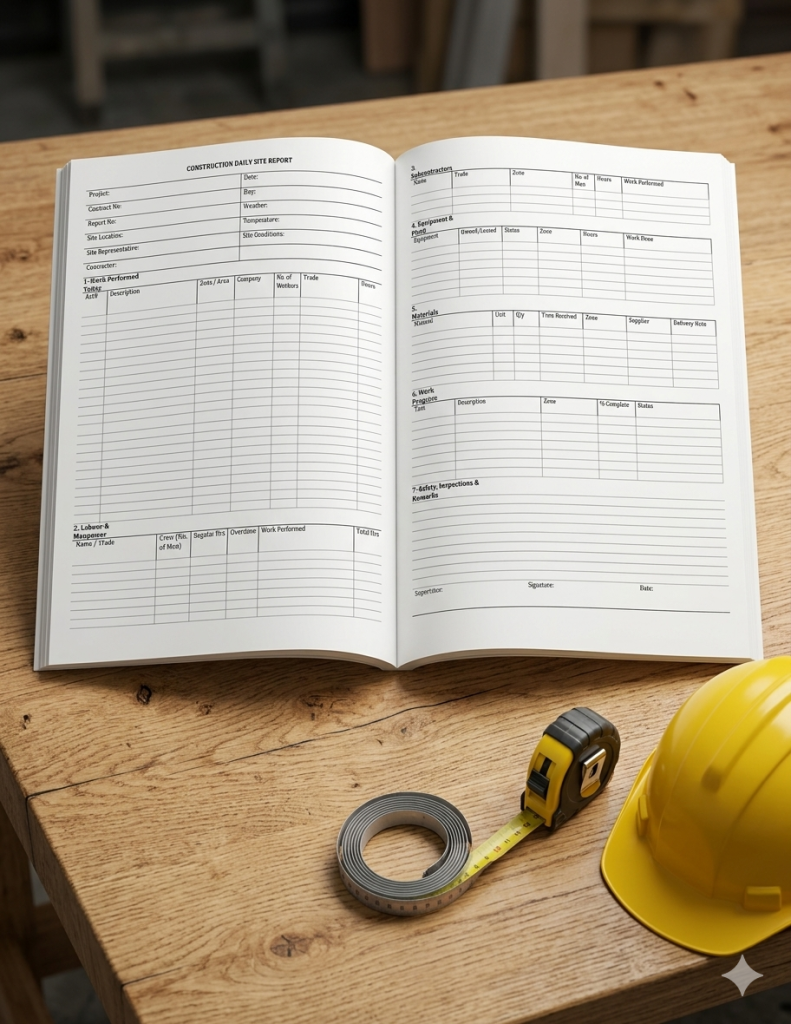
Daily Progress Reports – Track work done on site, labour, materials, equipment, subcontractors, site safety, and other inspections in one master logbook.
Essential for Contractor’s Foreman, Superintendents, Clerk of Works, and Site Supervisors.
Understanding the Construction Daily Site Logbook
A construction daily site logbook—sometimes referred to as a site diary or daily report book—is a structured record used to document everything that happens on a construction site each day.
It serves as a chronological account of site operations, capturing key details such as work progress, labour deployment, plant usage, material deliveries, weather conditions, and any issues encountered.
Unlike informal notes or scattered reports, a well-designed logbook ensures that all essential information is recorded in a consistent and organized format, making it easy to reference when needed.
The Importance of Daily Site Documentation
In a dynamic construction environment, conditions can change rapidly. Without proper documentation, these changes are easily forgotten, misinterpreted, or disputed. A construction daily site logbook eliminates this uncertainty by providing a reliable and permanent record of site activities.
One of the most significant advantages of maintaining a logbook is its role in dispute resolution. Construction projects frequently face disagreements over delays, variations, or payment claims. In such situations, the ability to present detailed, dated records can determine the outcome. Simply put, the contractor with the best records often has the strongest case.
Beyond legal protection, a logbook also enhances project control. By recording daily progress, managers can monitor productivity, identify inefficiencies, and ensure that work is proceeding according to plan. This level of visibility is essential for maintaining schedules and budgets.
What a Construction Daily Site Logbook Captures
A well-structured logbook goes beyond basic note-taking. It captures a wide range of information that reflects the full scope of site operations.
Each entry typically begins with general project details, including the date, project name, and contract reference. This establishes a clear timeline for all recorded activities.
Weather conditions are another critical component. Recording morning and afternoon weather, along with any lost working hours, provides valuable evidence for delay claims and extension of time requests. Even minor weather changes can have a significant impact on productivity, making this information essential.
Labour records form the backbone of daily reporting. By documenting the number of workers on site, their trades, and any overtime worked, the logbook allows for accurate tracking of workforce productivity. This data is particularly useful for contractors and quantity surveyors when analyzing labour efficiency.
Work progress is also documented in detail. This includes activities completed, areas worked on, and any ongoing tasks. Over time, these entries create a clear picture of how the project is advancing.
Plant and equipment usage is another vital section. Recording which machines were used, how long they operated, and any breakdowns helps in managing equipment costs and identifying inefficiencies.
Material tracking ensures that all deliveries and usage are accounted for. This reduces the risk of wastage, theft, or mismanagement, while also supporting cost control.
Finally, the logbook captures delays, issues, and safety records. Whether it’s a design change, labour shortage, or safety incident, documenting these events ensures transparency and accountability.
————————-
Stop Losing Money on Site Delays
Master your project documentation with the Macron Venter Construction Daily Site Logbook.
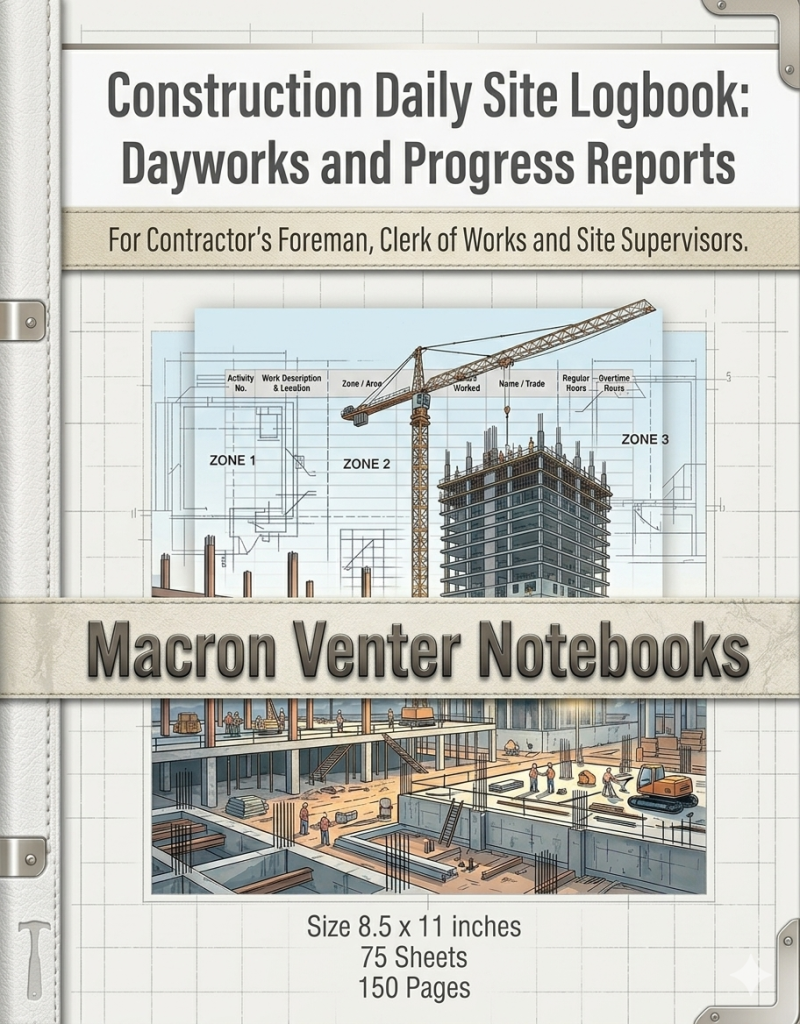
- ✅ Detailed Progress Reports: Never miss a site instruction again.
- ✅ Labour & Equipment Logs: Accurate tracking for Dayworks and variation claims.
- ✅ Audit-Ready: Professional layout designed for Contractors and Site Supervisors.
Enhancing Project Management Through Daily Logs
The construction daily site logbook is more than just a record—it is a management tool. By providing a detailed account of daily operations, it enables better decision-making at every level of the project.
For site managers, the logbook offers a clear overview of what has been achieved and what challenges need to be addressed. This allows for proactive problem-solving rather than reactive responses.
For contractors, it provides insight into resource utilization, helping to optimize labour and equipment usage. This can lead to significant cost savings over the course of a project.
For quantity surveyors, the logbook serves as a valuable reference when preparing interim valuations and verifying dayworks. It ensures that all claims are supported by accurate and consistent data.
Physical Logbooks vs Digital Solutions
With the rise of technology, many construction professionals are turning to digital reporting tools. While these systems offer convenience and automation, physical logbooks remain widely used—and for good reason.
A physical logbook provides a tamper-resistant record that is often more readily accepted in legal disputes. Unlike digital entries, which can be edited or deleted, handwritten records offer a level of authenticity that is difficult to replicate.
In addition, logbooks are always accessible, regardless of internet connectivity or device availability. On remote sites or in challenging environments, this reliability is invaluable.
That said, digital tools can complement traditional logbooks, offering additional features such as data analysis and remote access. Many professionals choose to use both, combining the strengths of each approach.
Practical Benefits for Construction Professionals
The value of a construction daily site logbook extends across all roles within a project.
Contractors benefit from improved cost control and documentation, ensuring that all work and resources are accurately recorded. Site managers gain better visibility into daily operations, enabling more effective supervision and coordination.
Foremen and supervisors use the logbook to maintain consistent records, ensuring that nothing is overlooked. Meanwhile, project managers rely on the information captured to monitor performance and manage risks.
For quantity surveyors, the logbook is particularly important. It provides the data needed to support valuations, verify work completed, and substantiate claims. Without this information, accurate cost management becomes significantly more challenging.
A Real-World Perspective
Consider a scenario where a contractor submits a claim for delays caused by heavy rainfall. Without documented evidence, the claim may be rejected outright. However, with a detailed logbook showing daily weather conditions, lost working hours, and affected activities, the claim becomes credible and defensible.
This example highlights the practical importance of maintaining accurate records. In construction, documentation is not just administrative—it is strategic.
—-
Master Your Site Reporting
The Ultimate Tool for Accurate Project Control
Front Cover
Internal Layout
By Macron Venter
- Dayworks & Progress: Streamlined tracking for labor and productivity.
- Material Monitoring: Precise logs for equipment and material usage.
- Professional Standard: Ideal for Foremen, Clerk of Works, and Site Supervisors.
- Site Inspections: Integrated forms for daily quality control.
Best Practices for Maintaining a Logbook
To fully benefit from a construction daily site logbook, consistency and accuracy are essential. Entries should be completed daily, without exception, to ensure that no information is lost.
Clarity is equally important. Descriptions should be detailed yet concise, avoiding vague or ambiguous language. Recording issues as they arise ensures that all challenges are documented in real time.
Using standard terminology helps maintain consistency across entries, making the logbook easier to understand and analyze. Finally, signing each entry adds a layer of accountability, reinforcing the credibility of the record.
Avoiding Common Pitfalls
Despite its simplicity, a logbook can lose its effectiveness if not used properly. Common mistakes include incomplete entries, backdating information, and failing to record critical details such as weather or delays.
Poor handwriting or unclear notes can also reduce the value of the logbook, making it difficult to interpret later. By avoiding these pitfalls, construction professionals can ensure that their records remain reliable and useful.
Choosing the Right Logbook
Not all logbooks are created equal. A professional construction daily site logbook should be designed with the needs of the industry in mind, offering structured sections that cover all key aspects of site operations.
Durability is also important, as logbooks are often used in challenging site conditions. Clear formatting and sufficient writing space ensure that entries can be completed بسهولة and efficiently.
Conclusion
The construction daily site logbook is a cornerstone of effective project management. It provides a structured, reliable record of site activities, supporting everything from progress tracking and cost control to legal protection and dispute resolution.
In an industry where details matter and accountability is critical, the importance of accurate documentation cannot be overstated. A well-maintained logbook ensures that every aspect of a project is recorded, creating a foundation for informed decision-making and successful project delivery.
Final Reflection
In construction, success is built not only on physical structures but also on information and accountability. While tools and technologies continue to evolve, the fundamental need for accurate daily records remains unchanged.
A construction daily site logbook may seem like a simple tool, but its impact is profound. It is, quite literally, the written history of your project—and in many cases, the key to protecting it.
Related Posts:
- Construction Daily Site Logbook: The Ultimate Guide…

- Construction Daily Site Logbook: The Complete Guide…
- Why You Need a Construction Cost Estimator /…

- 5 Tools for Efficient Construction Project Management
- 5 Tools for Efficient Construction Project Management
- Construction Cost Estimator vs. Quantity Surveyor –…

- Construction Cost Estimator vs. Quantity Surveyor –…
- BIM vs. Bills of Quantities. Will 3D Model Takeoff…

- Labour Only Building Rates in New Zealand